Posts Tagged ‘Flyfishing Tasmania’


End of season guiding specials & the RiverFly Tasmania webshop
April 7th, 2010 by Daniel


Autumn mayfly rise

Autumn mayfly rise

We are running a mayfly season guiding special for bookings of two or more days: our normal rates are $375 ea pp (for two anglers), however our multiple day bookings for between 9 April and 23rd of April are on special for $300pp, 0r $525 for a single angler (down from $620). Enquire here for availability and more details. April is one of our best months for mayfly hatches and match-the-hatch fishing.

With the season starting to wind down, Daniel and his team are starting to again fill custom fly orders. If you would like to orders some WMD’s for hopper feeders and the Western Lakes, or perhaps some classic Shaving Brush, just visit our shop icon in the top right corner and order away. Our Paypal payment sytem will process your payment, and the RiverFly team will start tying!


Tasmanian fly fishing pic of the day – Macquarie River, mayfly time

April 6th, 2010 by Daniel

Macquarie River

Autumn is mayfly time on the northern Tasmanian rivers. Moody thunderheads often sit in the distance, as plagues of iron-blue beatids hatch, drifting down the river on foam lines and eddies. It is in these currents that trout hunt their prey, and within these currents that our simple dry flies fool the wild trout.


RiverFly Tasmania fly fishing report – Autumn 2010

March 9th, 2010 by Daniel

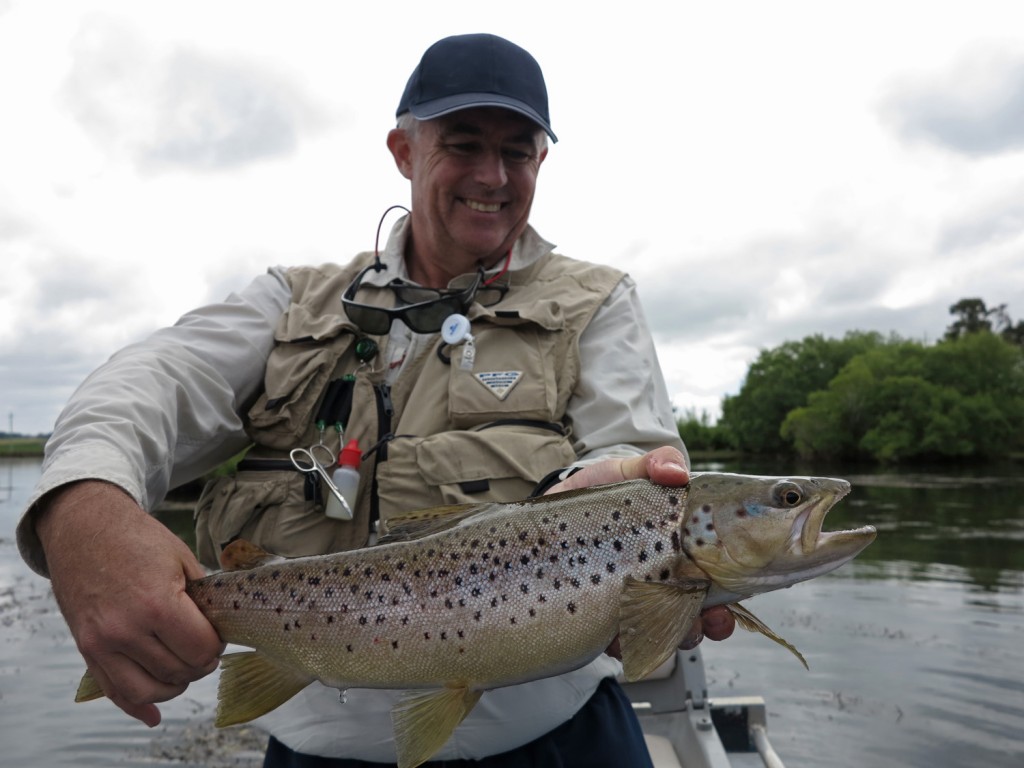
Wild Tasmanian hopper feeder


Gone Fishing…

 It’s been three months since our last fishing report, but with good reason: we’ve spent more than 50 days on the rivers since our last note, guiding through pre-Christmas red and black spinner falls, summer hopper hatches and the beginning of the autumn mayflies, and spent another 30 days out in the World Heritage Listed Western Lakes region, experiencing not only the sightfishing, but nature itself. We’ve found remnants of late 19th century grazing operations, old forgotten horse and cart tracks, not to mention a world of detailed minutiae: cushion plants and orchids, blue and red mountain hoppers, and ancient remnant pencil pine stands. 

 There have been many surprises this season, some owed in part to the end of the drought, some to new river venues, and some to our expanding Western Lakes Campouts. One common theme throughout them all has been constant: wild Tasmanian trout. Whether it’s been the super-conditioned trout of the Meander or lower Macquarie River, the flats cruising trout of the Western Lakes, or the hidden monsters of the fast-water river gorges, the aim of our days has revolved around core values of inspiring places, visual fishing opportunities and wild trout. If we can find these three goals, we know that the enjoyment of the day will take care of itself.  

 Current fishing report

 Autumn fishing has started in northern Tasmania, with large baetid mayfly falls on the lower Macquarie and Esk rivers, and ants appearing on humid days. This has created some classic match the hatch fishing, both from the raft and wading. Grasshoppers are still around and on the menu, and are proving effective at times–again, this has particularly been the case on the lower Macquarie River and a few of our other favourite haunts. The strong baetid hatches are expected to continue through March and April, to the close of the brown trout season at the start of May. 

 Summer highlights

 Summer highlights at RiverFly have been many and varied: young Rory sightfishing and landing a 4lb trout on the Meander, Frank and his six days of sight-fishing nirvana, high flows and great rafting on the post-drought Macquarie river, and the sight-fishing experience of the Western Lakes campouts with the three amigo’s Jappy, Mark and Curtis, the team of four Septuagenarians’, and many others. January was probably the best month of the season to date, with loads of blue-sky days, and early season hopper fishing. March could be a close contender to take the title though, especially if the ants and baetids keep on coming! 

Fishing Tips

1. When casting, always plan to present the fly ahead of the trout, rather than directly at it.

2. When practicing casting, focus on efficiency: learn to (1) cast line out quickly, (2) re-adjust casting length effectively, and (3) change casting directions smoothly.

 That’s all for now. If you have any questions about fishing in Tassie, don’t hesitate to Email us. Thanks from the RiverFly team–Daniel, Simone and Patrick. 


 Stay tuned to the RiverFly Blog for weekly updates and fishing reports.

Western Lakes Fly Fishing


South Esk River Draft Management Plan – Have your say now

November 18th, 2009 by Daniel

The South Esk Draft Management Plan was released a month ago, and has since taken all my spare time; the South Esk River is  Tasmania’s greatest river fishery, yet it is set to be destroyed under the Draft Management Plan which closes for public comment early December.

A summary of the major issues are as follows:

  • The Draft Plan ignores the advice of the Government’s own scientific advisors and recommends a continuation of the current minimum cease to take flows of 40ML/Day — this is more than 60% less than the recommended 100-160ML/Day environmental flows required to maintain and enhance the environmental conditions, and required to facilitate angling throughout the summer. The only reasoning that DPIPWE staff have given is that 40ML/Day is the status quo, and that irrigators would have to build their own dams for the collection and storage of high flows if their summer takes were reduced. This is a shocking justification, owing to the fact that trout population dynamics and invertebrate populations are being harmed 3 out of 5 years under the status quo, and Lake Trevallyn at the end of the South Esk in Launceston, has been closed for all water sports over the past two to three summers because of toxic algal blooms. The public needs to demand that the environmental flows recommended by the experts are adopted and enforced by the Plan, so that the environment of the river may recover, be maintained and/or enhanced. There are huge amounts of water available for irrigation, but it needs to be captured outside of summer and stored off-stream.
  • Irrigators were the only stakeholders consulted in the formulation of the Draft Plan—Northern Tasmania’s Natural Resource Management body (NRM North) were relegated to observer status without input, anglers were left out in the cold (even though up to 3000 anglers fish the river per year), and other recreational users of the river and Lake Trevallyn weren’t even considered.
  • The prescribed environmental flows are to be gauged at Llewellyn, along the Fingal Highway. This means that there is no environmental flow being guaranteed or monitored for the lower third of the river system, from Llewellyn through Glen Esk, Nile, Evandale, Longford, Hadspen or Launceston (into Lake Trevallyn). This is unacceptable, and environmental flows need to be guaranteed for the end of the river system.
  • During Summer low flow periods, the South Esk flows emanate from one large aquifer – this aquifer is now being used to grow in excess of 15,000 hectares of new tree plantations in the headwaters, using more water than traditional standing forest or agricultural land. Under the Water Management Act 1999, evapotranspiration (water use) by trees or plantations is not considered a water use, therefore the authors of the Draft Plan have not accounted for the increased consumption of these baseflows. What the water managers can do however, is plan to manage for reduced baseflow availability, which we need to ensure is accounted for. Without this allowance for decreased baseflows, the Draft Plan is incomplete.

In a nutshell, one of Tasmania’s most popular rivers will be destroyed by the Plan in its current draft state. The Draft Plan fails to meet its own listed Environmental Objectives (2.2.1 (a), (b), (d)) and Social Objectives (2.2.3 (a), (b), (c)) (from page 9). The Draft Management Plan also fails to meet its requirement to ‘ensure that environmental water receives a greater level of security than consumptive water’ (from page 34).  I ask that any concerned anglers, recreational users or clubs view the Draft Management Plan here and have your say by making a submission to:

Contact: Water Management Planning Officer

Henry Maxwell
Water Management Planning Officer
1 Franklin Wharf HOBART TAS 7000
Phone: 03 6233 4807
Fax: 03 6224 4977
Email: 
Henry.Maxwell@dpipwe.tas.gov.au

For those of you worried about losing access through private (irrigated) property by speaking out against ludicrous aspects of this plan, have a think about this: if the plan goes through, the river will die a death of a thousand cuts, and there will be no river fishery left to access. The future of the river is in our hands – will you speak out, or let it die through a lack of action?  The deadline for written representations is 11 December 2009, feel free to cut and paste from my comments.

Tasmanian fly fishing - mayfly hookup

Tasmanian fly fishing - mayfly hookup


Wild Tasmanian trout picture of the day – Mayfly hook-up

November 4th, 2009 by Daniel
Tasmanian fly fishing - mayfly hookup

Tasmanian fly fishing - mayfly hookup

Ronald from Belgium, setting the hook on another Tasmanian mayfly feeder. Spring has sprung, the mayfly are on, and the fisheries are firing. My picks for spring are the South Esk, St Patricks and Upper Macquarie rivers, but the Meander is also producing some great fishing, along with the Mersey and Brumbys Creek.


Next Page »