Archive for the ‘Western Lakes’ Category


RiverFly Wilderness Huts – Western Lakes – Opening October 2012

After 3 1/2 years of hard work and planning, we are excited to announce that we will be opening RiverFly Wilderness Huts in October 2012!

RiverFly Wilderness Huts are located adjacent to the famous Western Lakes & Walls of Jerusalem National Park / World Heritage Area.
The hut project has been a massive project for us, and is the first project of its kind in Tasmania to combine wilderness fly fishing and conservation. Of this we are extremely proud. This outcome means that for every customer that visits RiverFly Wilderness Huts, a slice of Tasmania is protected forever.
Here is a link to the webpage and further details http://riverfly.com.au/riverfly-wilderness-huts/ . Keep an eye on our newsletter and blog for more information, and we are taking bookings now.
Thanks, Dan and Simone Hackett.


Western Lakes campouts – sustainable eco-tourism into the future

Season 2010/2011 will again see RiverFly Tasmania running our Western Lakes Campouts. In 2009, RiverFly became the first fly fishing business licenced by Parks and Wildlife Tasmania to operate in the Western Lakes. This is something we are very proud of.

This licensing ensures that our guides operate to environmental, operational and safety management plans. Key features of these plans include:

• Minimising environmental impacts.

• Alleviating any conflict with other anglers – part of our Operational Plan was created to ensure that we bypass any waters being fished by other anglers, as a measure of courtesy.

• As a key requirement of our Safety Management Plan, all campouts are run with two guides.

In addition to these rigorous management plans, our formal licencing requires a small payment back to Parks and Wildlife Tasmania for administration and park management costs.

RiverFly Tasmania are proud to be leading the way in sustainable, licenced fly fishing operations in the World Heritage Area / Western Lakes.

How are our current camps run?

Our current camps depart from Lake Ada, where we commence on foot to Talinah Lagoon, and onwards into the greater Christys Creek Area. The greater Christys Creek area, along with the Pillans / Julians are the only two areas within the Western Lakes that licenced commercial operators are allowed to camp (as per the World Heritage Area Management Plan).

Our campsite was chosen after weeks of exploration and site assessments in 08/09, followed by on-site consultation with Parks and Wildlife managers. We did not take this process lightly, and it was worth the effort: our site is visually hidden from other anglers, and away from popular trout waters and foot traffic. This ensures privacy for all anglers in the area.

Our typical camps consist of 3-4 traditional hiking tents, with Trangia and gas burners used for cooking. All of our food is fresh, and carried in for the trip. Of course, all waste is carried back out, along with any other rubbish found during our tips. To date we have also carried out nearly a dozen additional cans and bottles left as litter over the years by other careless users.

As per the regulations of the World Heritage Management Plan, all of our camps are restricted to a maximum of 6 anglers. However, RiverFly goes one step further and restricts its campouts to a maximum of 4 customers.

During season 09-10 we were fortunate to spend more than 35 nights camping-out in the Western Lakes. We only encountered seven other anglers (whom by coincidence were all found fishing the same lake at various times!). In addition, we were able to co-ordinate assistance for one elderly bushwalker who was injured on the track between Christys Lagoon and Lake Antimony, with a storm front approaching.

Environmental Best Practice and managing our Environmental Impact into the future

As an eco-tourism business working in a delicate World Heritage Listed environment, we are always looking at ways of decreasing any potential environmental impacts, whilst continually improving our customer experience. To achieve this, RiverFly Tasmania has submitted an application to Parks and Wildlife Tasmania to install a seasonal toilet pod and temporary tent platforms at our secluded location.

Whether its commercial or recreational, two of the possible impacts from any camping relates to the trampling of delicate flora around campsites (particularly under tents), and issues relating to the disposal of human and grey-water waste. These are both areas that RiverFly Tasmania is looking to minimise, and manage to World’s Best Practice.

To do its part and minimise impacts, RiverFly Tasmania is planning to install seasonal tent platforms. These platforms will only be on-site  for the season, and would mean that our tents don’t sit-on or smother any plant life in the area. Such platforms are already used by Parks Tasmania to minimise impacts on the Overland Track and Walls of Jerusalem National Parks, and by private operators in the Walls of Jerusalem National Park, South West WHA and Maria Island National Park.

To manage human waste, and any contaminated water from dish-washing, RiverFly is also applying to install a small toilet-pod at the secluded campsite. This would mean that all human waste and contaminated water would be flown-out and disposed of outside of the World Heritage Area, ensuring that we are protecting our delicate water courses into the future. It is planned that the toilet-pod would be emptied each May, after the close of the fishing season. This prevents any possible or perceived conflict between other users of the area and the short (30min) use of the helicopter.

As a final element of our proposal, RiverFly will be limiting the number of fly fishing campouts we run each season. From our plans we will be spending a realistic maximum of 70 days per season in the Western Lakes, with our fishing effort being spread across 30 or more waters. Considering that literally thousands of nights are currently spent by anglers in the Western Lakes, our real impact on visitation numbers in the area will be tiny—Lake Ada alone sees more than 900 angler days of use per season, to put things into perspective . This minimal-impact camp will provide  jobs for Tasmanian’s, increased awareness of the value of recreational fishing in the Western Lakes, and the opportunity for anglers to learn more about the fishing, flora, fauna and history of the Western Lakes.

The camp approval process

Our application is currently with the Tasmanian Parks and Wildlife Service, and is being assessed through a process called the Reserve Activity Assessment. This assessment ensures that all aspects of the World Heritage Management Plan are met by the proposal. As part of this formal process, public consultation will occur, which will be run in partnership between Parks and Wildlife Tasmania, and RiverFly Tasmania.

Upon a successful final approval, RiverFly will enter into a contract with the Tasmanian Parks and Wildlife Service. This would see our business pay a commercial lease back to Parks and Wildlife Tasmania (and the Tasmanian people), which will then be used to manage our great National Parks and World Heritage Areas. This is a great example of how our small business can contribute directly back to the management of the Western Lakes for the future.

Re-enforcing the World Heritage Area values

As we work towards environmental best practice, there are a few things that we definitely won’t be doing:

1. We will not be applying to fly customers into the Western Lakes. We believe that one of the greatest parts of the Western Lakes fishery is the remoteness, and the need to use your own energy and initiative to get there. This remoteness and solitude is further protected by the WHA Management Plan, which actually prohibits the use of helicopters to take anglers in/out of the WHA.

2. We will not be building a private hut or lodge! One of the great enjoyments of our Western Lakes campouts is indeed the camping. In a world full of stuffy-office blocks and hotel rooms filled with recycled air, we can see the value and appeal of sleeping under the canvas. As such, our camp will remain as just that – a tent camp utilising tents for accommodation. To ensure these values are protected in the Western Lakes, the WHA actually prohibits the building of private huts or lodges in the World Heritage Area.

If you have any further questions, please feel free to contact Daniel Hackett at RiverFly Tasmania.  Further details will be made available as assessed by Parks and Wildlife Tasmania. You can read testimonials, including those from campout customers here


RiverFly Tasmania fly fishing report – Autumn 2010

Wild Tasmanian hopper feeder


Gone Fishing…

 It’s been three months since our last fishing report, but with good reason: we’ve spent more than 50 days on the rivers since our last note, guiding through pre-Christmas red and black spinner falls, summer hopper hatches and the beginning of the autumn mayflies, and spent another 30 days out in the World Heritage Listed Western Lakes region, experiencing not only the sightfishing, but nature itself. We’ve found remnants of late 19th century grazing operations, old forgotten horse and cart tracks, not to mention a world of detailed minutiae: cushion plants and orchids, blue and red mountain hoppers, and ancient remnant pencil pine stands. 

 There have been many surprises this season, some owed in part to the end of the drought, some to new river venues, and some to our expanding Western Lakes Campouts. One common theme throughout them all has been constant: wild Tasmanian trout. Whether it’s been the super-conditioned trout of the Meander or lower Macquarie River, the flats cruising trout of the Western Lakes, or the hidden monsters of the fast-water river gorges, the aim of our days has revolved around core values of inspiring places, visual fishing opportunities and wild trout. If we can find these three goals, we know that the enjoyment of the day will take care of itself.  

 Current fishing report

 Autumn fishing has started in northern Tasmania, with large baetid mayfly falls on the lower Macquarie and Esk rivers, and ants appearing on humid days. This has created some classic match the hatch fishing, both from the raft and wading. Grasshoppers are still around and on the menu, and are proving effective at times–again, this has particularly been the case on the lower Macquarie River and a few of our other favourite haunts. The strong baetid hatches are expected to continue through March and April, to the close of the brown trout season at the start of May. 

 Summer highlights

 Summer highlights at RiverFly have been many and varied: young Rory sightfishing and landing a 4lb trout on the Meander, Frank and his six days of sight-fishing nirvana, high flows and great rafting on the post-drought Macquarie river, and the sight-fishing experience of the Western Lakes campouts with the three amigo’s Jappy, Mark and Curtis, the team of four Septuagenarians’, and many others. January was probably the best month of the season to date, with loads of blue-sky days, and early season hopper fishing. March could be a close contender to take the title though, especially if the ants and baetids keep on coming! 

Fishing Tips

1. When casting, always plan to present the fly ahead of the trout, rather than directly at it.

2. When practicing casting, focus on efficiency: learn to (1) cast line out quickly, (2) re-adjust casting length effectively, and (3) change casting directions smoothly.

 That’s all for now. If you have any questions about fishing in Tassie, don’t hesitate to Email us. Thanks from the RiverFly team–Daniel, Simone and Patrick. 


 Stay tuned to the RiverFly Blog for weekly updates and fishing reports.

Western Lakes Fly Fishing


Fly fishing tasmania – wild trout pic of the day

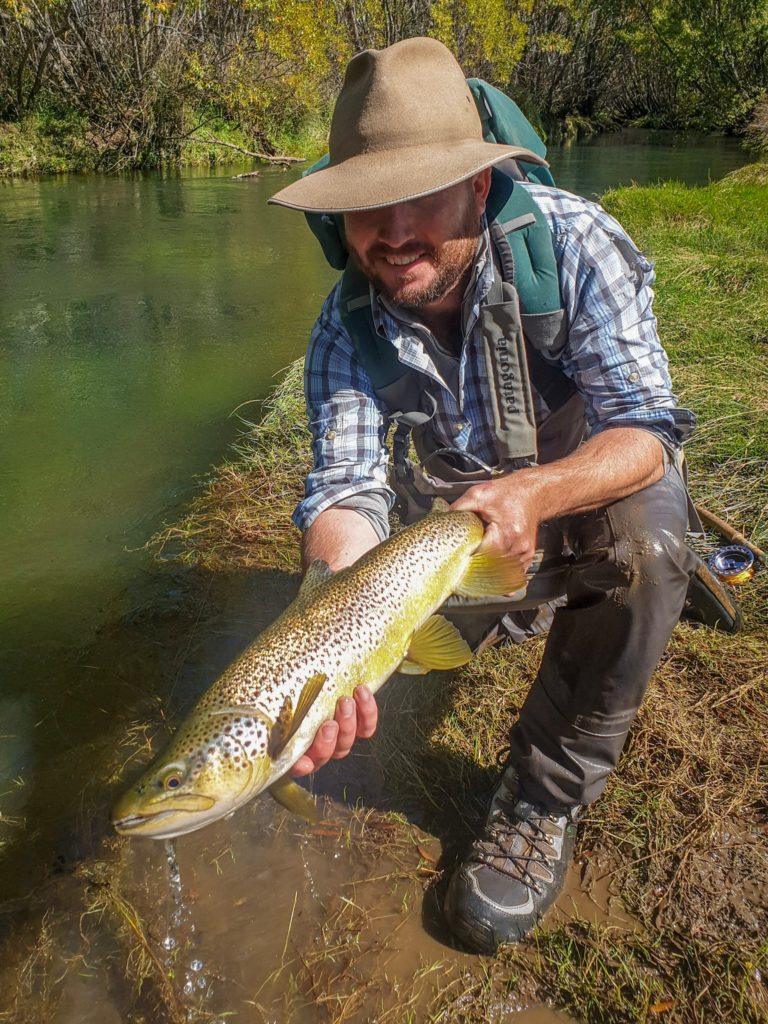
Fly fishing Tasmania, wild trout of the day: RiverFly’s youngest customer, Rory, releasing his 4lb catch of the day. Rory polaroided this very fat, very wild brown trout, and hooked it on his second cast! Well done.

Rory and his wild Tasmanian trout

The river fish are well and truly on the hoppers, with the our WMD Hopper proving deadly. It’s been a freaky fortnight on the rivers, with more than 13 three-pound trout coming to hand, all polaroided, and all on the WMD hopper.

We’ve also been busy with Western Lakes Campouts, with the usual mix of blue sky days, and cracked up cloudy days providing both polaroiding days and mayfly days. January was an extremely dry month on the Central Plateau (19mm of rain compared to the average 120mm), so the best waters to head to have been deepwater lakes and their drop-off edges. These cruising trout have been averaging 2 1/2  to  3 1/2 pounds.

Finally, with a break from routine, here is a second pic of the day created by Mother Nature and fires on the West Coast: picture location, Western Lakes three nights ago.

Bushfire sunset, Western Lakes Tasmania

Bushfire sunset, Western Lakes Tasmania


Western Lakes Fly Fishing – pic of the day

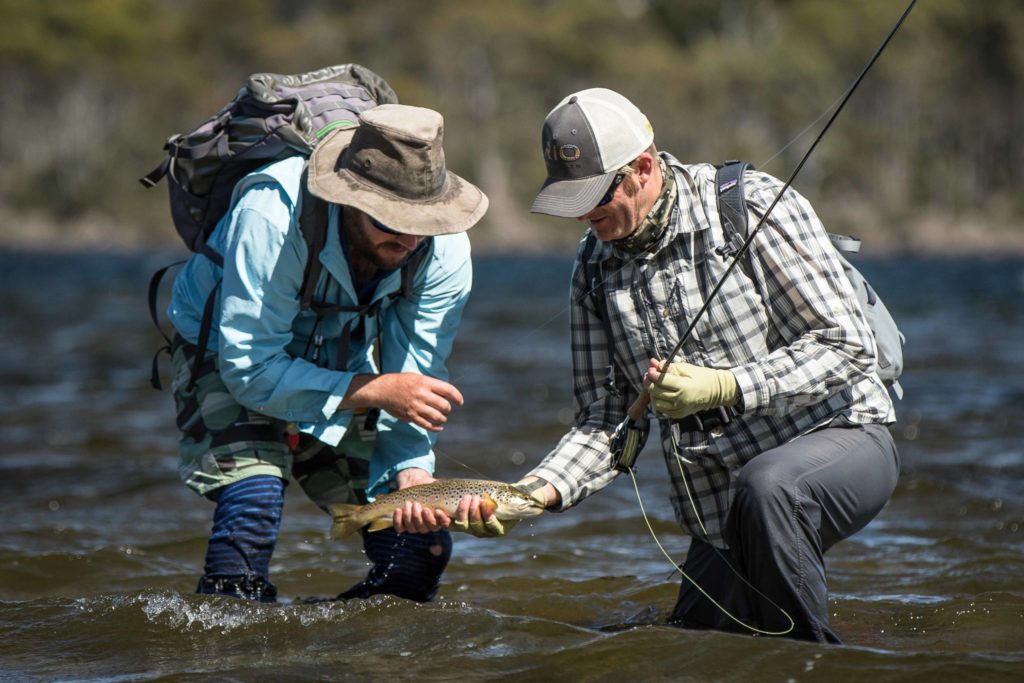
Flats style fishing for trout - Western Lakes Tasmania

Flats style fishing for trout - Western Lakes Tasmania

The Western Lakes trout are on fire, with flats-cruising brown trout averaging between one and two pounds heavier than normal, due to the great winter and spring flooding. Main food items are early morning caddis, late evening midges, and daytime galaxia, with the average trout size ranging from 2 1/2 pounds to 6 pounds.

 Back down on the lowlands, and juvenile hoppers are starting to interest river trout on the South Esk, St Patricks and Meander rivers, and most of the creeks in between – the tiny granite-spring creeks of the north-east are fishing exceptionally.

If you would like to join Patrick and I for a Western Lakes wilderness campout, Email us now. We have a couple of spaces left on trips booked for January and April. RiverFly Tasmania is Tasmania’s only guiding operation licenced to work in the Western Lakes World Heritage Area.